

Out of Sections, Not Out of Options: Adding to an Existing Switchboard
Buildings grow. Switchboards don't. An industrial plant adds a production line. A mixed-use building signs commercial tenants for the ground floor. Sooner or later, that growth lands in the electrical room, at a switchboard sized for the building as it was, not the building it's becoming.
When the existing lineup runs out of capacity, the fix is an additional section. And that's exactly where a costly misconception kicks in.
The nameplate misconception
Ask around, and you'll hear the same assumption: whoever built the switchboard has to build the addition. One nameplate on the board, one manufacturer allowed to touch it, or so the thinking goes.
Follow that assumption and you're a captive customer. You get one quote, at one price, on one timeline. And depending on the manufacturer, that timeline can stretch to lead times that no project schedule survives. The plant expansion waits. The tenant build-out waits. Everyone waits on a single section of gear.
You're not locked in
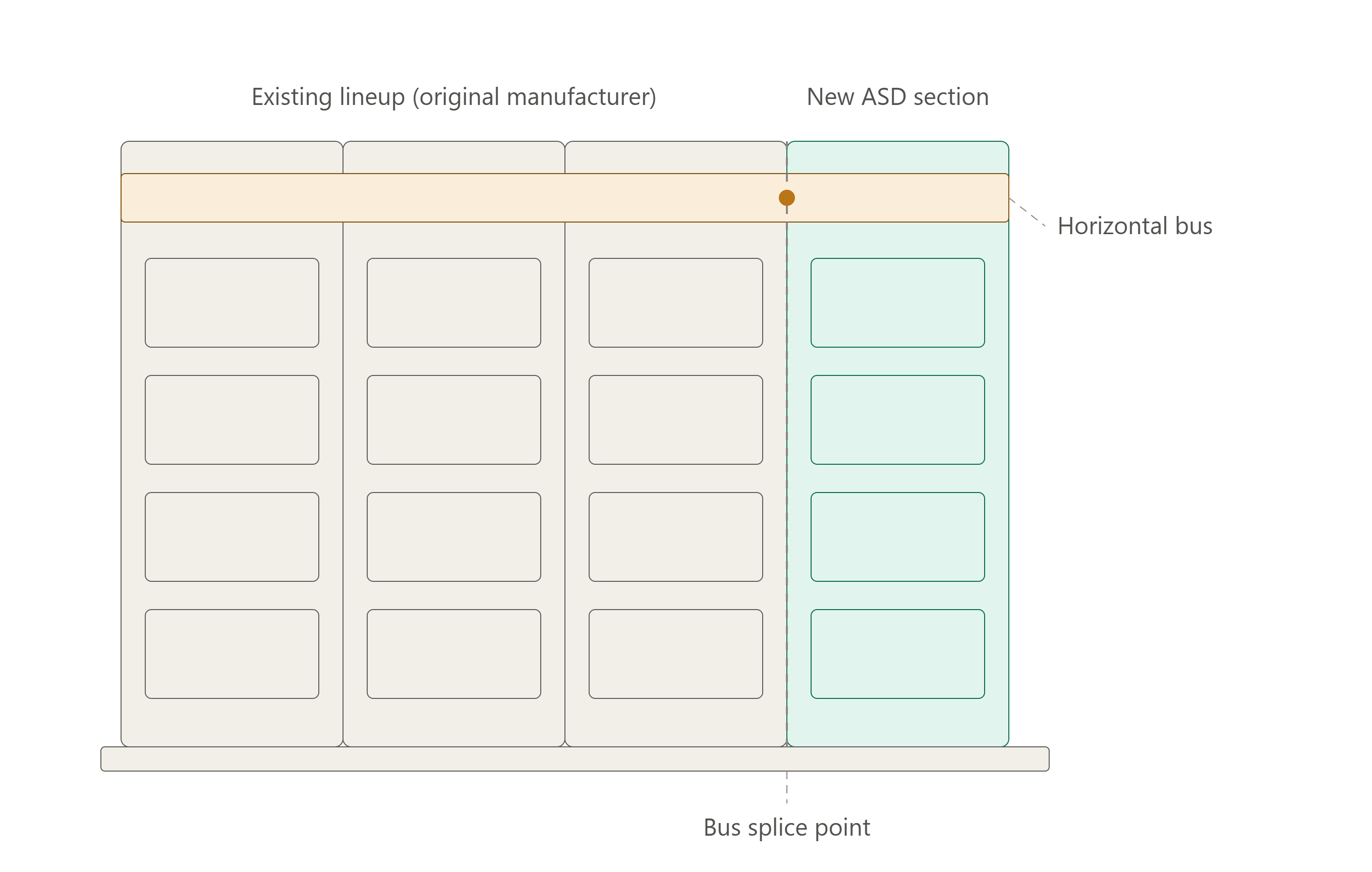
Here's what many customers don't know: the addition doesn't have to match the nameplate. ASD builds add-on switchboard structures that are manufacturer agnostic, engineered to bus connect to your existing switchboard, whoever originally built it.
The new section ties into the existing bus, aligns with the existing lineup, and carries the capacity your expansion needs. It's simply built by a shop that can deliver it much faster than many national manufacturers.
Why it matters
The payoff shows up in three places that plant managers, developers, and contractors care about most:
Schedule. An add-on section built on a quick-ship timeline instead of a national manufacturer's backlog can be the difference between an expansion that opens on time and one that idles waiting for gear. When the section is the critical path, weeks matter.
Options. A second qualified source changes the conversation. Instead of accepting the original manufacturer's price and lead time as given, you can compare and choose the path that fits your budget and your schedule.
Capacity without replacement. Extending the lineup means the working switchboard you already own keeps doing its job. You add what the expansion needs instead of ripping out and replacing gear that has years of service left in it.
Where this fits
This approach is a strong fit for industrial plants adding equipment and load, and for mixed-use residential buildings bringing on new metered commercial tenants. Anywhere load growth has outrun the spare capacity in the existing board, a manufacturer-agnostic add-on is worth putting on the table, ideally early, while the schedule still has room to flex.
Every existing lineup has its own bus rating, dimensions, fault current, and utility considerations, so the right add-on depends on the specifics of the gear in the room. But the principle holds: the company that built your switchboard doesn't have to be the company that expands it.
Let's look at your lineup
If an expansion is pushing your existing switchboard past its limits, and the original manufacturer's lead time is pushing your schedule past its own, we're happy to review the lineup with you. As a UL-listed, American-made manufacturer, ASD builds custom power distribution equipment engineered around the gear, the space, and the schedule you're actually working with.
Request a quote or reach out to talk through your project.